
TDEE Calculator For Tracking Your Daily Calories
Your Total Daily Energy Expenditure (TDEE) is the number of calories your body burns in 24 hours, including sleep, digestion, walking around and training. Enter five details below in TDEE calculator and you will get your maintenance calories, BMR, BMI, and macro targets for losing fat, holding steady or gaining muscle. Free, no signup, and every calculation runs in your browser.
Free Calculator
TDEE Calculator
Find your daily calorie needs, BMI, ideal weight and macros — calculated instantly in your browser. Nothing you enter is ever sent to a server.
Calories at Every Activity Level
See how your maintenance calories change with activity — your selected level is highlighted.
| Activity Level | Calories / day |
|---|
Body Mass Index (BMI)
A general screening measure of weight relative to height.
Ideal Weight
Estimated using four widely referenced formulas, plus their average.
| Formula | Ideal Weight |
|---|
Macronutrients
Suggested daily protein, carb and fat targets for three common goals.
Energy Intake to Reach Your Goal
Daily calories needed to lose or gain weight at different paces.
To Lose Weight
| Pace | Per day | Per week |
|---|
To Gain Weight
| Pace | Per day | Per week |
|---|
One or more targets above fall below commonly recommended minimums (about 1,200 cal/day for women, 1,500 cal/day for men). Very low-calorie diets should only be followed under medical supervision.
Private by design — every calculation runs in your browser. Nothing you enter is stored on our servers.
Total Daily Energy Expenditure (TDEE) is the total number of calories a person burns in one day. It is estimated by calculating basal metabolic rate (BMR) and multiplying it by an activity factor between 1.2 and 1.9. Eat at your TDEE and body weight holds steady; eat below it and you lose weight; eat above it and you gain.
For most adults in the United States, estimated TDEE falls between roughly 1,600 and 3,000 calories per day, depending on sex, body size, age and how much they move.
What TDEE is made of
Your daily burn is not one number — it is four, stacked together.
|
Component |
What it covers |
Share of TDEE |
|---|---|---|
|
BMR (basal metabolic rate) |
Keeping you alive at rest: heart, lungs, brain, kidneys, cell repair |
~60–70% |
|
NEAT (non-exercise activity thermogenesis) |
Everything you do that isn’t a workout — walking, standing, chores, fidgeting |
~15% (highly variable) |
|
EAT (exercise activity thermogenesis) |
Deliberate training sessions |
~5–15% |
|
TEF (thermic effect of food) |
Energy spent digesting and absorbing what you eat |
~10% |
Two things surprise most people here. First, the workout is the smallest controllable slice — an hour in the gym is usually 300–500 calories, while NEAT can swing by 800 calories a day between a desk worker and a nurse on their feet. Second, TEF is not equal across foods: protein costs roughly 20–30% of its own calories to process, versus about 5–10% for carbohydrate and 0–3% for fat. That is one practical reason higher-protein diets tend to feel more forgiving.
How to Use Your TDEE Calculator?
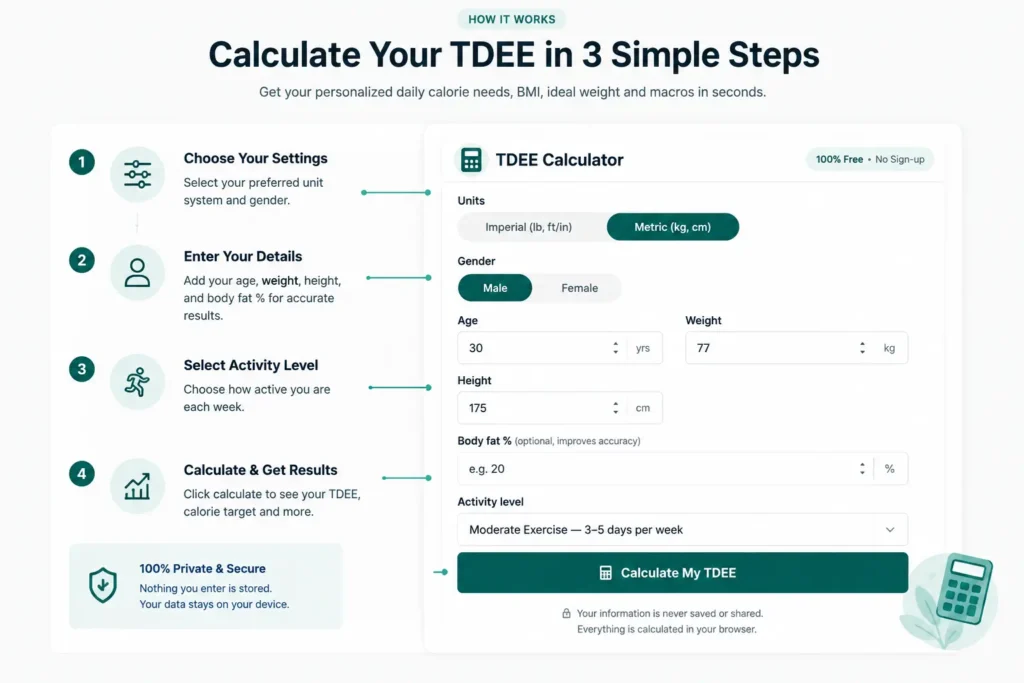
Using a TDEE calculator is easier than you think; no complex formulas are required. Simply input your age, weight, gender, height, and activity level, and TDEE will estimate your exact calorie needs within seconds with a single click. Use it for 2–3 weeks while tracking your weight; even if your calorie intake ranges from 1,500 to 3,500, it will still provide good results. Whether you are looking to lose fat, build muscle, or create a surplus, knowing these numbers becomes your starting point and gospel truth for fitness success. Weigh your goals against your TDEE, avoid fat accumulation, and hit your targets.
How TDEE Is Calculated?
TDEE involves a simple purpose: simply multiply your basal metabolic rate by your activity level factor. The number of equations discovered to detect your calories, but Mifflin- St Jeor and Harris-Benedict equations are more accurate; one of each demands age, weight, gender, and body mass. Many experts use TDEE to estimate energy level according to your activity; daily routines and lifestyle influence your routine. The calculating method is very simple:
BMR X Activity Level = TDEE
We use the two equations that clinical dietitians actually use, and we show you which one applied to your result.
The Mifflin-St Jeor Equation
The Mifflin-St Jeor equation is considered one of the most accurate formulas for calculating BMR. This equation updates the older method to calculate the total daily energy expenditure. Modern TDEE calculators use this formula, factoring in age, gender, weight, and height. It has become popular among nutritionists and fitness professionals alike.
Case Study:
Sarah (34 yrs, 70kg, 165cm) had a weight-loss plateau using generic calculators. Her nutritionist applied the Mifflin-St Jeor formula:
This was 300 calories lower than her previous estimate. Adjusting her intake to match, she lost 4kg in 6 weeks.
What to do with your number
|
Goal |
Daily target |
Expected rate |
|---|---|---|
|
Maintain weight |
TDEE |
Stable |
|
Gentle fat loss |
TDEE − 250 |
~0.5 lb (0.25 kg) per week |
|
Standard fat loss |
TDEE − 500 |
~1 lb (0.5 kg) per week |
|
Lean muscle gain |
TDEE + 200 to +300 |
~0.5–1 lb per month, mostly lean |
|
Faster bulk |
TDEE + 500 |
Quicker on the scale, more of it fat |
Bigger gaps in either direction mostly buy you a worse experience. Aggressive deficits cost you sleep quality, training performance and lean mass; aggressive surpluses just add fat you will have to diet off later.
Floors matter. Do not go below about 1,200 calories a day (women) or 1,500 (men) without medical supervision, and try not to eat below your BMR for extended periods. Very low intakes make it hard to hit protein and micronutrient needs, and the research on prolonged severe restriction shows meaningful drops in NEAT and resting metabolism — your body quietly makes the deficit smaller.
TDEE Calculator Methodology
You want to know how the TDEE calculator actually works? It’s not as complicated as it seems. The method starts with your
Basal Metabolic Rate (BMR) – your body burn calories during resting
Activity Multiplier (AM) – multiplies your calories while you are active
After applying the above steps, TDEE shows your number. This tool is trusted by experts like the American Council on Exercise (ACE). If you understand this calculation, you will be able to know the effects of food and activity on your body.
Thermic Effect of Food
When you eat something, it gives you calories, and some calculated amount will be used to break down its complex part. It depends on your diet, which you eat. If you intake more protein than fat, then the protein will increase your calorie burn level. For example, if TDEE is between 2500 and 3000 calories, it will impact how much energy your body burns, but mostly people miss this: protein burns extra energy to boost fat loss.
Activity Factors Explained
If someone works a desk job with less exercise, you’re at :
Add weekly training sessions like walking, yoga, and light gym; at your level, it will become 1.5. If you exercise twice or more a week, your activity level is 2. But if you are doing athletics and heavy labor 4-6 days a week, it could reach 2.5 to 3.0. One of each activity level can change your calories significantly. Select at least one of these levels that matches your activity, job, and lifestyle, and see unexpected results to reach your goals.
Basal Metabolic Rate (BMR)
The energy that burns in your body during rest, like during breathing and thinking, keeps your body functioning and going on. Factors like age, weight, height, etc. determine the TDEE number. The younger you are, the higher will be your BMR. These caloric needs are the beeline of your TDEE calculation.
How accurate is a TDEE calculator?
Honestly: within about ±10% for most healthy adults, and occasionally further off than that.
TDEE cannot be measured directly outside a lab. The gold standard is doubly labeled water, which is expensive and not something you can do at home. Every online calculator, including this one, is running a population-average regression on five inputs — so two people with identical age, height, weight and sex can genuinely burn 300+ calories a day apart because of differences in lean mass, thyroid function, gut microbiome, medication, sleep and NEAT.
The estimate tends to drift most for:
- People with high muscle mass or very low body fat (use the body fat field — Katch-McArdle handles this better)
- People with obesity, where sex-based formulas can overestimate
- Adults over 65, where lean mass loss is not captured by weight alone
- Anyone with a thyroid condition, PCOS, or on medication that affects appetite or metabolism
None of this makes the number useless. It makes it a starting hypothesis rather than a fact — which is exactly how to use it.
How to calibrate your real TDEE in three weeks
This is the part most calculators skip, and it is the part that actually works.
- Week 0 — set the target. Eat at your calculated TDEE. Do not change training.
- Weigh consistently. Same time each morning, after the bathroom, before eating, 4–7 days a week. Record it.
- Use the weekly average, not the daily reading. Day-to-day weight moves on water, sodium, carbohydrate and digestion. Compare week 1’s average to week 3’s average.
- Read the result.
- Average held within ~1 lb → your estimate was good. That is your maintenance.
- Average rose → your true TDEE is lower. Subtract 150–200 calories.
- Average fell → your true TDEE is higher. Add 150–200 calories.
- Recalculate every 10–20 lb of body weight change. A lighter body burns less. This is the most common reason a diet that worked for eight weeks suddenly stops working — the old target is no longer a deficit.
Three weeks of honest tracking will tell you more about your metabolism than any formula on the internet.
Who should not rely on this TDEE calculator
TDEE equations were validated on healthy adults. Treat the output as unreliable, and speak to a doctor or registered dietitian, if you are:
- Pregnant or breastfeeding
- Under 18
- Managing a medical condition that affects metabolism or appetite, including thyroid disorders and diabetes
- Recovering from illness, surgery or injury
- Living with, or in recovery from, an eating disorder
If calorie tracking makes food feel stressful rather than manageable, that is a reason to stop and talk to someone, not to track harder. In the US, the National Alliance for Eating Disorders helpline (1-866-662-1235) is staffed by licensed clinicians.
Learn How Many Calories You Burn Every Day!
Want to know exactly how many calories you burn daily? The TDEE calculator is the fastest way to calculate the calories you burn daily. It gives you exact statistics by analyzing your BMR, BMI, and daily expenditure. No need to wander; start your track with precise value.
Why TDEE matters with weight?
Your TDEE is the gap between your current size and your fitness goals—it determines everything about weight management. Whether you want fat loss or muscle gain , your TDEE is the calorie target that makes the change happen. Understanding your TDEE helps you balance protein and fats in meal planning and boost your performance. Your BMI, BMR, and energy expenditure measures unlock the training results that you want.
Can you increase your TDEE?
Your TDEE is not fixed, it totally depends on your activity. Strength training sessions help you to build muscle mass that burns your calories when you’re at rest .Little activities i.e, exercise, walk after dinner or use stairs instead of lift, convert your BMR into a higher number. Smart eating patterns like vegetables, fruits, grains, seeds and proteins support your nutrition and decrease your appetite. Together with these habits you can build a stronger, more efficient body that supports your weight loss plan.
Frequently Asked Questions
This TDEE Calculator provides you with general educational information, not medical advice about your weight loss.